
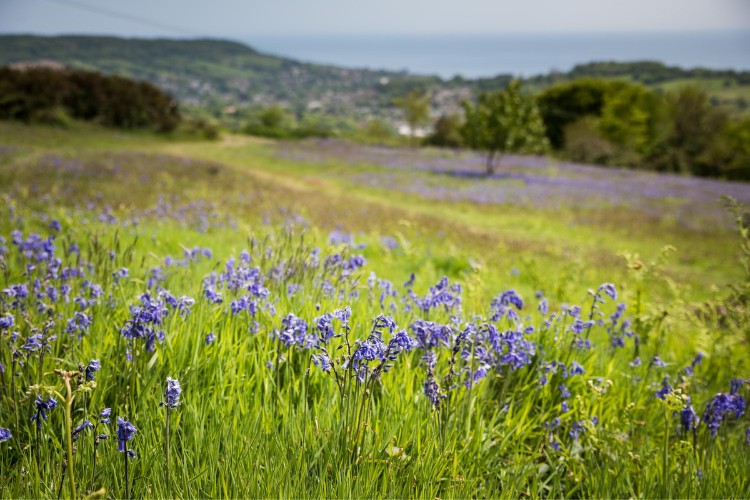
Climbing up from the hamlet of Bowd near Sidmouth you will follow roads and footpaths through fields to reach the heathland summit of Fire Beacon Hill Nature Reserve. From here, on a clear day, you can enjoy spectacular views out towards Sidmouth and the coast before dropping down through woodland and fields to Harpford Wood and the former railway to Sidmouth.
There are optional detours along an ancient beech avenue and down to a viewpoint looking west out over the Otter Valley. .
Additional Information
Fire Beacon Hill was one of the sites where a beacon was lit to warn Elizabethan London that the Spanish Armada was coming.
The Feniton to Sidmouth branch line railway closed in 1967. Part of the old railway between Tipton St John and Bowd is now a cycle path
Directions
1 - 5. From the Bowd layby or adjacent bus stop...
…walk downhill towards Bowd on the path alongside the main road and turn left along the road towards Tipton St John. Take care here as there is a short stretch without pavements that can be busy at times and you will need to cross over.
2. Walk past the Bowd Inn and the low brick walls on either side of the road (these are the parapets of the bridge over the old railway line) and turn immediately right along the narrow Fire Beacon Lane. It is a quiet road, but you may need to step aside for tractors and horses.
3. When the road turns to the left go straight on along the footpath that follows Saltways Lane, signed as a no through road.
4. Continue straight on into a farmyard and follow the waymarked track on the right leaving the first barn on your right and the looseboxes and house on your left. Continue along the unsurfaced track and through a gate into a field.
5. Keeping close to the fence on your right walk straight on to a stile. Climb over the stile and turn left up an enclosed track. Carry on up the hill, ignoring a footpath on the right, until you cross a small stream and come to T-junction of paths.
6 - 10. Turn right to reach a narrow plank bridge and another stile.
Cross the bridge and stile and head straight on across the field to another stile. Climb over into a narrow road.
7. Turn left and continue up the hill to a small parking area where the road becomes an unsurfaced track.
Detour One – Core Hill (Adds 1 mile/1.7 km to the route)
To visit Core Hill and its avenue of ancient beech trees turn right through the car park and through the gap in the fence and take the lower path which curves up a Combe for 153 yards/140 metres. When the path starts to bear left turn right up a steep earth bank for 22 yards/20 metres and then at the top turn right again between the beech trees and follow the footpath along the ridge for half a 755 yards/690 metres. The path stops at the end of the hill and you must retrace your steps.
8. Follow the wide track as it continues up the hill. It is stony and rough in places. After approx 350 yards/320 metres the hill levels out.
Short Cut One (Reduces walk by 755 yards/ 690m)
At this point look out for an unmarked track with a metal bollard that goes off left through the trees. Keep left and left again to emerge from the trees along a narrow path with magnificent views over Sidmouth and out to sea. There are a number of benches where you can rest and savour the views.
Short Cut Two (Reduces walk by 842 yards/770m)
If you miss the unmarked track, a signed footpath 175 yards/160 metres further on takes you across the centre of the hill on another short cut path through woodland and across the open heath.
9. Carry on along the track for another 600 yards/550 metres to join the East Devon Way and bear right to Hollow Head Cross.
10. Turn left down the track for approximately 33 yards/30 metres to a T-junction to look out over the Otter Valley. Retrace your steps to the main track at Hollow Head Cross and turn right. You are now following the East Devon Way until waypoint 8. Retrace your steps for 131 yards/120 metres.
11 - 15. At the fork bear right ...
and then almost immediately left along a well-used beech-lined woodland track for 219 yards/200 metres until you reach a gate into Fire Beacon Hill Local Nature Reserve.
12. Go through the gate and, where the path divides shortly afterwards, take the left hand footpath and cross the heathland.
13. Carry straight on and look out for the footpath coming in from the left and, as the track starts to descend, look out for the short cut also coming in from the left. Follow the bridleway downhill, ignoring side turnings, and into the trees.
14. Bear left and then look out for a sharp right turn opposite a noticeboard. Turn right and continue along the path until you come out on a minor road.
15. Turn right along the road for 77yards/70 metres and look for a footpath on the left.
16 - 20 Turn left down the steps...
and go through a metal kissing gate into a large field. There are views out over the Otter Valley and Newton Poppleford from here.
17. Make your way to the right hand field boundary and follow the hedge down to the bottom of the fields. You may see donkeys in these fields from the Donkey Sanctuary near Salcombe Regis, 3.3 miles/5.4km to the south east.
18. Cross the track between the fields and go through a kissing gate following the footpath around to the left and through another gate to reach the Bowd to Tipton St John road.
19. Go straight across onto a footpath on the other side, taking care as this road can be busy at times. Follow the footpath into Harpford Wood.
20. After a short distance turn left at the junction of paths and follow the path downhill through the trees. Carry on descending on the path, which can be rough and steep in places, until you see a railway bridge.
Detour Two – exploring the goyle
To take this detour continue straight on under the railway bridge and down the rough track. At the bottom turn sharp left leaving the East Devon Way. This path can be slippery, but gives a good insight into the power of water that has cut a deep furrow – known locally as a goyle – in the surrounding rock. Look out for ferns along the side of the stream as you follow the bank.
Where the path divides keep right on the footpath eventually crossing a small stream and continuing until the path eventually leaves the stream at a waymark. Follow the path as it climbs uphill between two wire fences until you pass out through a gate to the Bowd to Tipton St John road. Turn right taking care along the short stretch of road without pavements and then right again to the bus stop or layby.
21 -22 At the railway bridge leave the East Devon Way...
…and climb up the steps on the right. On reaching the track bed turn left and follow the old railway track until you come out through a gate onto the Bowd to Tipton St John road.
22. Turn right, taking care along the short stretch of road without pavements, and then right again to retrace your steps to the bus stop or layby,
This route was originally developed by James Baldwin and checked by Ted Swan. It was reviewed and updated in 2025.