
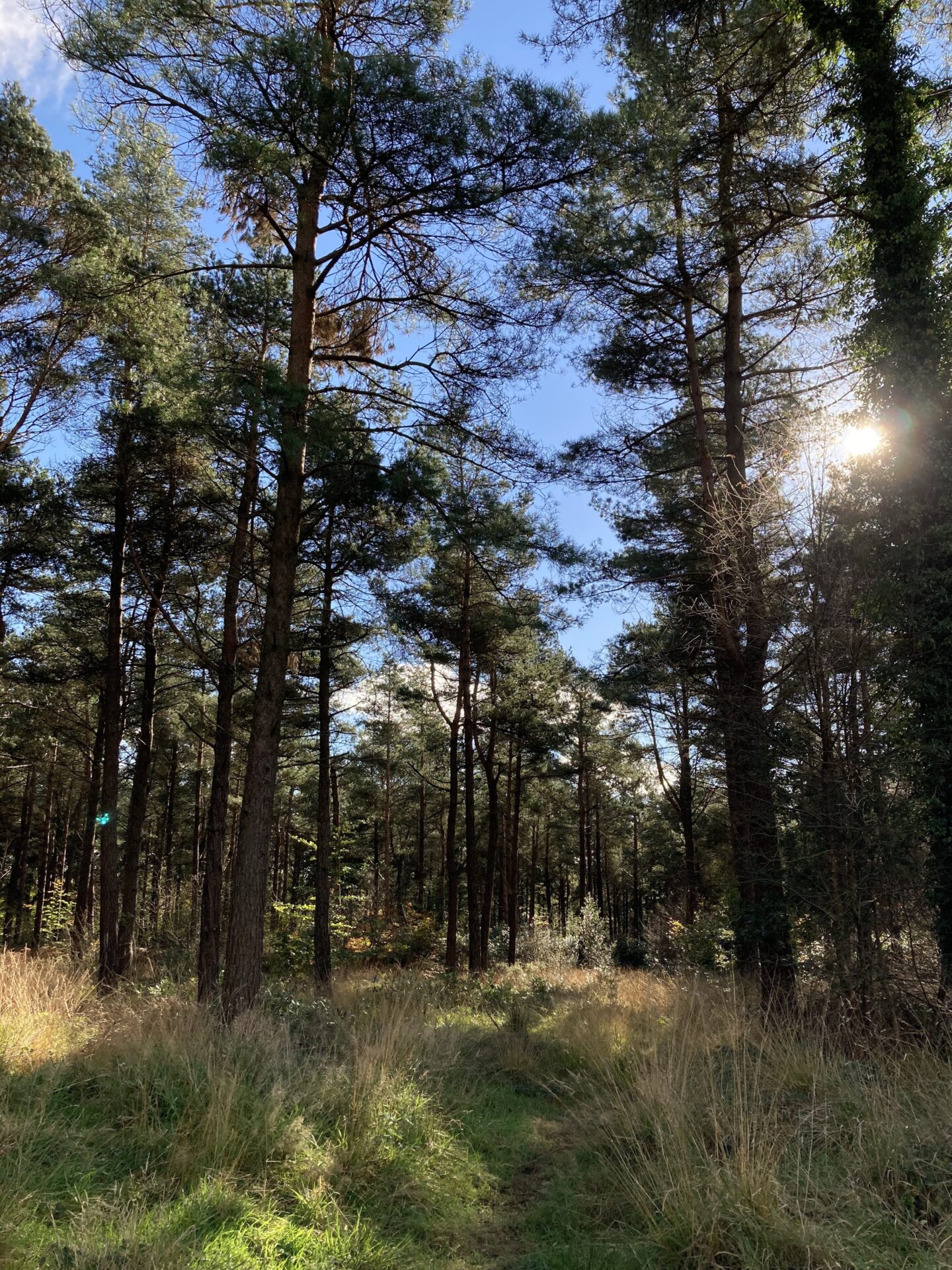
Starting at Axminster Railway Station and joining the East Devon Way near Uplyme, this route takes you on a wonderful journey up and over Trinity Hill which is now a Local Nature Reserve supporting a wide range of species including Dartford warbler and nightjar.
Travelling on through the plantations on Hoyton Hill you will have a chance to learn about the changes that are being made to prepare our forests for the future, before dropping down towards Uplyme Pinetum which contains many specimen trees that date back to the 1840s – 1860s including a champion yew, which is an exceptional example of its species due to its size.
Additional Information
The name Axminster has been synonymous with carpet manufacture since 1755. However, when a disastrous fire destroyed the factory, production was paused in the town for some time. In 1937 the manufacturing of carpets was relaunched in the town and continues in Axminster to this day. Carpets made in Axminster have been designed for the Royal Household and can be found in luxury houses around the world.
Trinity Hill has the remains of 17th century beacon and beacon house near the highest point. Although there is no longer evidence of the beacon house above ground, the Scheduled Monument with its low flat-topped earth bank and surrounding ditch can still be seen. It is thought to be an unusual and relatively late type of beacon and an important part of the coastal defences at the time.
Directions
1 - 5. Turn left out of Axminster Station and follow the road around to the right.
Go straight across King Edward Road into Widepost Lane and follow it straight on to Musbury Road.
2. Turn right and after approx 131 yards/120 metres take the first left along Boxfield Road and follow it into Moreton Way. Continue along Moreton Way until you come to the edge of the fields.
3. Turn right at the junction of paths and follow the footpath down over a footbridge and up the other side to a gate onto a minor road. This section can be wet and muddy at times.
4.Turn left along Woodbury Lane and then after a short distance take the footpath on your right.
5. Go along a short section of track and through a 2 in 1 gate into fields. Follow the footpath through three fields bearing right to a stile out onto a minor road.
6 - 10. Turn left along the road and through an underpass.
Shortly afterwards turn right over a stile onto another footpath through fields.
7. Follow the footpath staying parallel with the field boundary on your left until you come to a gate out onto a minor road.
8. Turn left along the road and after approximately 131 yards/120 metres turn right along a footpath up a lane.
9. Follow the footpath uphill along the lane, ignoring all side turnings, to reach Trinity Hill. Look for a path on your left.
10. Turn left and follow the path to a junction of paths. Turn right and follow this path to Trinity Hill Road.
11 - 15. TAKE CARE crossing Trinity Hill Road to Trinity Hill Local Nature Reserve car park.
Enter the Nature Reserve through the gap beside the metal barrier bearing left to an information board. Leave the board on your left and follow the right hand path straight on until it comes to a T-junction of paths.
12. Turn right and follow the path along the edge of the Nature Reserve. Where the path divides by a bench, keep left and follow a narrow bridleway to join a forestry track. Turn right along the track to the next junction.
13. At the T-junction of tracks turn left and continue to follow the bridleway along the track ignoring side turnings until you come to a bridleway on the left.
14. Turn left down the bridleway and follow it ignoring all side paths until you come to a minor road.
15. Turn right and follow the road for approx 470 yards/430 metres along the edge of the woodland before taking the first left down Cathole Lane.
16 - 20 Continue to a hairpin bend...
… and turn right along a bridleway following it downhill ignoring all side turnings and passing the entrance to the Pinetum. You will eventually join the East Devon Way at a minor road.
17. From here you can:
Turn left for Lyme Regis
Turn right for Musbury
21 -22 At the railway bridge leave the East Devon Way...
…and climb up the steps on the right. On reaching the track bed turn left and follow the old railway track until you come out through a gate onto the Bowd to Tipton St John road.
22. Turn right, taking care along the short stretch of road without pavements, and then right again to retrace your steps to the bus stop or layby,
This route was originally developed by James Baldwin and checked by Ted Swan. It was reviewed and updated in 2025.