
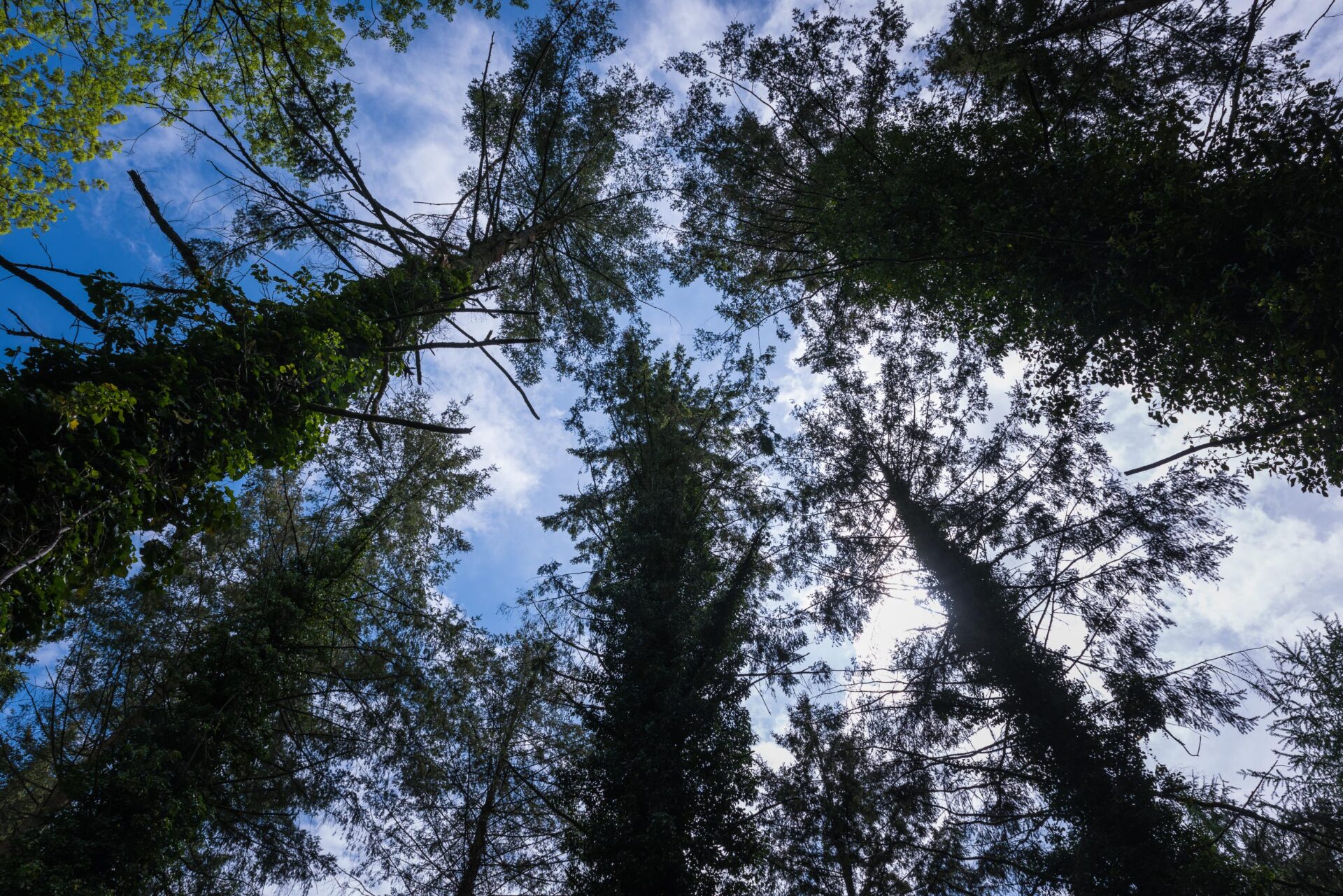
Starting and finishing in Trinity Hill Local Nature Reserve, this route takes you on a journey through the heaths and woods to the north west of Lyme Regis.
There’s the chance to see many different heath and woodland birds, to enjoy the shade of some giant beech trees that are known as some of the ‘Great Trees of East Devon’ and to enjoy rural views out over Cannington Viaduct.
Along the way you can find out how Forestry England is increasing the diversity of forests to make them more resilient to climate change and what they’re doing to lock up more carbon. Trinity Hill is also a Dark Skies Discovery Site, so a great place to stargaze.
This walk part of the East Devon Way Circular Walk Series: Route 13.
Additional Information
A landscape of history
Trinity Hill has the remains of 17th century beacon and beacon house near the highest point. Although there is no longer evidence of the beacon house above ground, the Scheduled Monument with its low flat-topped earth bank and surrounding ditch can still be seen. It is thought to be an unusual and relatively late type of beacon and an important part of the coastal defences at the time.
Important wildlife
Trinity Hill Local Nature Reserve is an important area of mainly acidic lowland heath with three different types of heather – bell heather, ling and cross-leaved heath. It is the home to many species of bird, look out for the brightly coloured yellowhammer and the dusky Dartford warbler, listen for the melodious linnet, the chirr of the nightjar at dusk in summer, and the clack of the stonechat. It is also an important area for moths including the True Lover’s Knot, Peppered Moth and the Drinkler. You may also see common lizards on patches of sun warmed exposed sandy soil.
Directions
1. Enter the Nature Reserve through the gap beside the metal barrier bearing left to an information board
Leave the board on your left and follow the right hand path straight on until it comes a T-junction of paths.
2. Turn right and follow the path along the edge of the Nature Reserve.
Where the path divides by a bench, keep left and follow a narrow bridleway to join a forestry track. Turn right along the track to the next junction.
3. At the T-junction of tracks turn left
and continue to follow the bridleway along the track until you come to a track leading off to the right.
4. Turn right and follow this bridleway along the track through the woods.
You will pass some large beech trees alongside the path which are described as some of the ‘Great Trees of East Devon’.
5. Continue to follow the track along the edge of the woods until you come to a T-junction of tracks.
Turn right and follow the track to the road.
6. Turn left along the road
and continue until you see a footpath sign on your right.
7. Turn right along the footpath
and follow it to another road.
8. Turn left along the road.
The East Devon Way comes in from the right, but follow the road down the hill for approximately half a mile/850 metres passing a road turning to the right.
9. Look for a bridleway on your left
and follow it up and through a gate into a field. Bear right along the field boundary until you come to a gate into woodland.
10. Go through the gate into the wood
and follow the bridleway to a T-junction of tracks.
11. Turn left along a bridleway and walk up the hill past a house
on the right to a T-junction with Cathole Lane on a hairpin bend.
12.Turn left up the hill and follow the road to another T-junction.
Turn right and follow the road for approx 470 yards/430 metres along the edge of woodland to find a bridleway on your left.
13. Turn left up the bridleway
and follow it ignoring all side paths until you come to a T-junction with a wider forest track.
14. Turn right along the forest track
and follow it ignoring all side turnings until the track flattens out and you come to a bridleway along a track on the right. Turn right along it.
15. Continue to follow the track, then just before the gate turn left
along the narrow bridleway back into the Nature Reserve. At the junction of paths by the bench you can either go straight on and retrace your steps to the car park, or turn left and follow a different path taking the first right by some wooden rails and continuing to the car park.
This route was originally developed by James Baldwin and checked by Ted Swan. It was reviewed and updated in 2025.